

You do not need to become an AI expert to benefit from AI
Scientific research is built on curiosity, observation, experimentation, and the development of new ways to understand the world. For generations, physicists, engineers, chemists, and researchers across many other disciplines have developed sophisticated methods to investigate complex problems.
Today, artificial intelligence (AI) and machine learning (ML) are adding new possibilities to this scientific toolkit. These technologies can help researchers analyze large datasets, recognize patterns, automate certain tasks, and explore relationships that may be difficult to identify using conventional approaches alone.
But there is an important question that is often overlooked: How does a scientist with deep expertise in physics, chemistry, or engineering actually implement AI into their research? Knowing your scientific field and knowing how to develop a machine learning model are two different skill sets. Bringing them together is where the real opportunity lies.
AI is not limited to computer science
When people hear about AI, they often think of chatbots, image generators, or automated software. However, machine learning can also be applied to much more specialized scientific problems.
Consider a chemist studying the properties of materials. Their research may involve collecting measurements under different experimental conditions and looking for relationships between composition and observed behavior. A machine learning model could potentially help identify patterns in those measurements or estimate a property for new combinations of inputs.
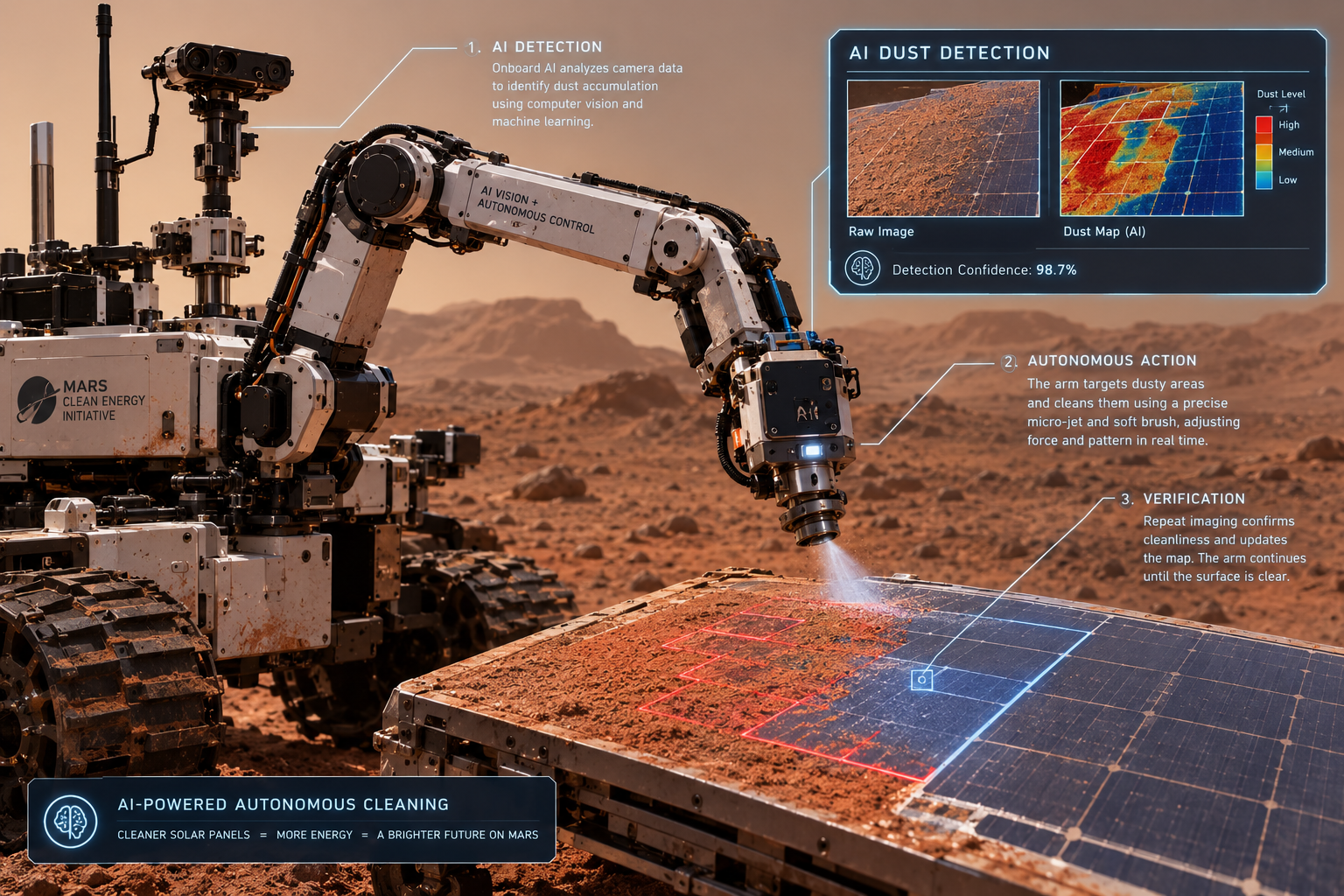
Similarly, an engineer working with images of a physical system might be interested in automatically identifying specific structures or defects. Computer vision techniques could help detect those features, provided that suitable data and validation methods are available.
A physicist analyzing experimental measurements could explore whether machine learning can help classify observations, identify relevant patterns, or build a model that complements existing physical understanding.
In each case, the scientific question comes first. AI is a potential tool for answering it.
The challenge: knowing where to start
Imagine you are a researcher who has spent years studying a particular physical phenomenon. You know the relevant equations, understand the experimental setup, and can interpret the measurements. You may already have a substantial collection of data. You begin to wonder whether machine learning could help you extract more information from your experiments.
But where do you start? Should you use a neural network, a decision tree, or a simpler statistical model? Do you have enough data? How should the data be prepared? What exactly should the model predict? How will you know whether its results are scientifically meaningful? These are not merely programming questions. They require a combination of scientific understanding, data analysis, and machine learning expertise. Choosing a sophisticated model does not automatically produce better science. Sometimes, a simpler method is more appropriate, easier to interpret, and more suitable for the available data.
The challenge is not simply to apply AI. It is to apply the right method to the right scientific problem. Imagine a research institute studying how a material behaves under different conditions. The researchers collect experimental measurements, recording variables such as temperature, composition, and a measured physical property. The scientific team understands the experiment and knows which variables matter. However, they would like to investigate whether the collected data contains patterns that could help them estimate the material’s behavior under conditions not yet tested.
An AI consultant working alongside the researchers could help structure the problem. The result of such a collaboration is not a replacement for the scientific method. It is an additional method that researchers can evaluate and potentially incorporate into their work.
Why collaboration matters
A successful scientific AI project requires more than technical implementation. The researcher understands the scientific problem, the experimental context, and the meaning of the measurements. The AI specialist understands the available computational methods, their assumptions, and their limitations. Neither perspective should be treated as secondary.
For example, a model might achieve apparently good predictive performance while relying on an unintended pattern in the data. If measurements from the same experiment appear in both training and evaluation sets, the results may give an overly optimistic impression of how well the model generalizes.
A scientist who understands the experimental process and an AI specialist who understands model evaluation can work together to identify such problems. This collaboration helps ensure that the computational method serves the scientific question rather than driving the research in an arbitrary direction.
AI consulting for scientific research: bridging two worlds
For many research institutes, building an entire in-house AI team may not be practical for every project. At the same time, researchers should not have to abandon their scientific work to become machine learning specialists before they can explore these technologies.
This is where specialized AI consulting can provide value. A consultant who understands both scientific research and AI can help translate a research question into a computational problem, assess whether machine learning is appropriate, select and evaluate methods, and support their integration into existing workflows. The objective is not to introduce AI simply because it is a popular technology. It is to identify where AI can genuinely contribute to the research and where conventional scientific or computational methods may remain more suitable.
At KlinDustAI, we aim to support research institutes in implementing AI and machine learning into scientific topics, combining computational expertise with an understanding of the needs and constraints of scientific research.
The future of research is collaborative
AI is creating new opportunities across scientific disciplines, but those opportunities do not remove the need for domain knowledge, experimental rigor, or critical thinking. The most meaningful applications emerge when researchers and AI specialists work together, each contributing the expertise needed to understand the problem and evaluate the solution.
You do not need to become a machine learning engineer to begin exploring AI in your research. You need a scientific question worth investigating, a realistic understanding of your data, and the right collaboration to determine whether AI can help. The goal is not to turn every scientist into an AI specialist. It is to make AI a useful part of scientific research.