

When dust becomes a mission-critical problem
In engineering and scientific exploration, some of the most important challenges are not necessarily the biggest or most visible ones. Sometimes, a seemingly insignificant layer of dust can become a serious obstacle to the success of an entire mission.
Dust is everywhere: on Earth, in industrial environments, and on the surfaces of planets and other celestial bodies. Its effects depend on where it accumulates, what it is made of, and which components it interacts with. In some situations, dust is simply a nuisance. In others, it can interfere with the very systems that a mission depends on. This is why dust mitigation deserves a place in the early stages of mission planning, rather than being treated as an afterthought.
A small particle, a big consequence
Imagine a robotic exploration mission equipped with cameras, scientific instruments, and solar panels. Each component has a specific role: cameras help the robot observe its surroundings, scientific instruments collect information about the environment, solar panels convert sunlight into electrical energy.Dust on an optical surface can reduce image quality or interfere with measurements. Dust on solar panels can reduce the amount of sunlight reaching the photovoltaic cells, lowering their electrical output. Dust entering mechanical systems can also create challenges for moving parts, depending on the design and operating environment.
None of these effects necessarily means that a mission will fail. However, when a system depends on several interconnected components, a problem affecting one of them can have consequences for the entire operation.For example, if a robot relies on solar energy and its panels become significantly less effective at collecting sunlight, the available energy for other activities may decrease. Depending on the mission design, this could limit how often the robot can operate its instruments, communicate, or move. The original problem is dust accumulation. The consequences can extend much further.
Why dust mitigation is not just cleaning
When we think about dust mitigation, we often imagine removing dust from a surface. But effective mitigation involves much more than that. It begins with understanding the problem. Where does dust accumulate? How quickly does it build up? Which surfaces are affected? What properties does the dust have? How does its presence influence the performance of the system? These questions are essential because different environments require different approaches.
A method that works for a solar panel in a terrestrial installation may not be suitable for an optical instrument on a spacecraft. The available energy, environmental conditions, material constraints, and maintenance possibilities can be very different. This is where systematic observation and data analysis become valuable.
By monitoring dust accumulation and identifying patterns, it becomes possible to better understand when cleaning may be necessary, which surfaces require attention, and how mitigation strategies can be adapted to the environment.
Where artificial intelligence can make a difference
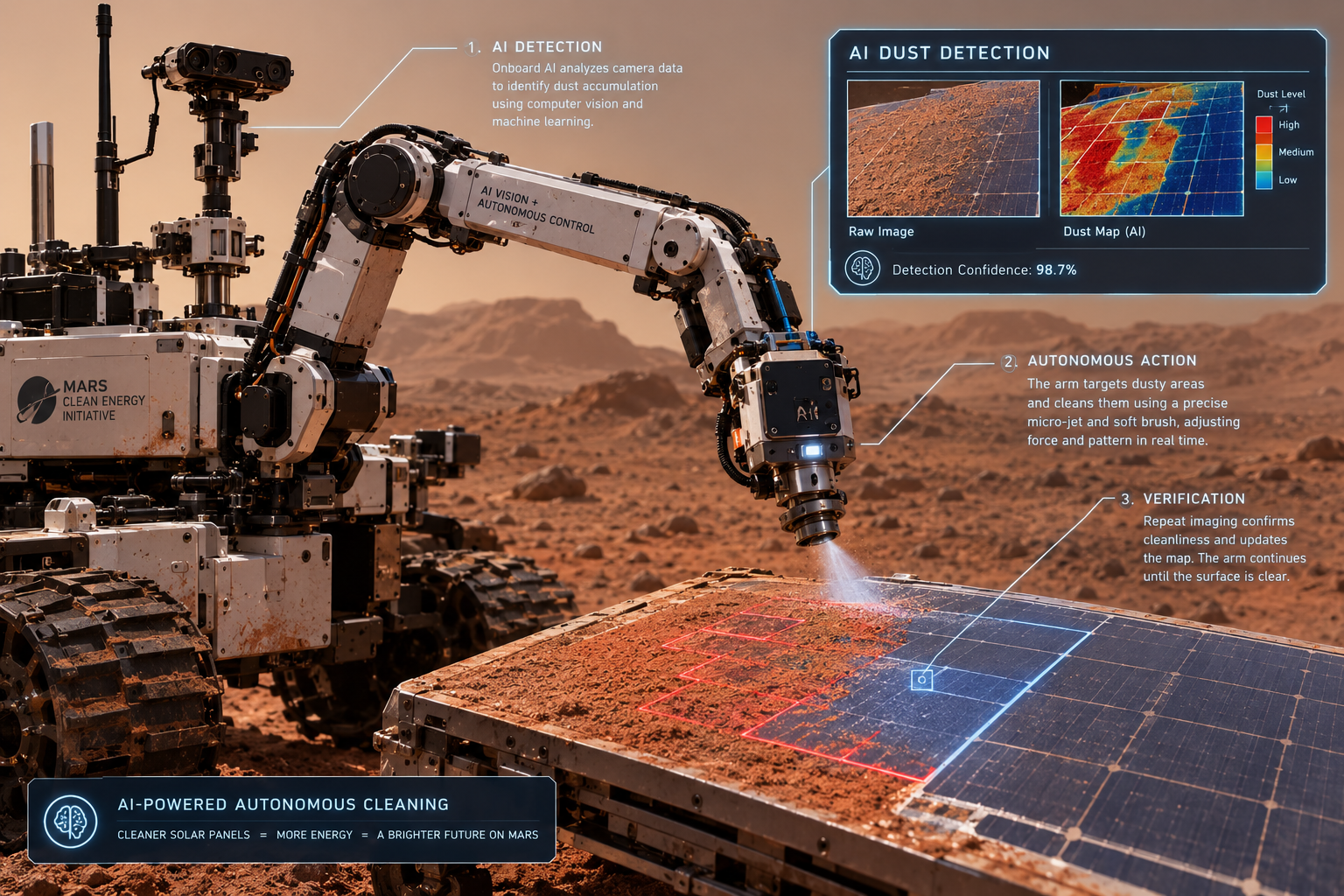
Dust is not always distributed uniformly. Its accumulation can vary across surfaces, over time, and with changing environmental conditions. Artificial intelligence (AI) and computer vision offer tools for analyzing this variability. For example, an AI-powered system could be developed to analyze images of a surface, identify regions affected by dust, and estimate how much of the surface is covered. With suitable training data and validation, such a system could support monitoring and help prioritize cleaning activities.
Consider a large installation with multiple solar panels. Instead of treating every panel as equally affected, an image-based monitoring system could help identify which areas appear to have accumulated more dust. This information could support maintenance planning and help direct attention where it is most needed.
The important distinction is that AI does not automatically solve the physical problem of dust. Rather, it can help us recognize, quantify, and understand the problem, providing information that supports better mitigation decisions. The usefulness of such a system depends on the quality of its data, the conditions in which it operates, and how well its predictions have been validated.
From reactive cleaning to informed mitigation
A conventional approach might be to clean a surface at fixed intervals or when its performance noticeably decreases.
A data-driven approach offers another possibility: monitoring the surface and using observed conditions to inform maintenance decisions.
For instance, if a system can reliably identify dust accumulation and relate it to relevant performance measurements, it may help determine whether cleaning is necessary, how urgently it should be performed, and which areas should receive priority. This does not eliminate the need for engineering expertise. It makes that expertise more effective by providing additional information. In complex missions, where maintenance opportunities may be limited, the ability to detect and understand a developing problem can be particularly valuable.
Dust mitigation starts with understanding dust
A successful mission depends on many interconnected decisions. Dust mitigation is one of the pieces that must fit into this larger picture. It requires knowledge of the environment, the materials involved, the affected systems, and the practical limitations of cleaning. AI can contribute by transforming images and measurements into useful information about dust accumulation and its potential consequences.
At KlinDustAI, we are working toward AI-powered software for dust recognition and mitigation, with the goal of helping researchers and engineers better understand this often-overlooked challenge.
Because sometimes, the difference between a problem we react to and a problem we can manage begins with a simple question:
Can we recognize the dust before it becomes a mission-critical issue?